29 Apr 2026
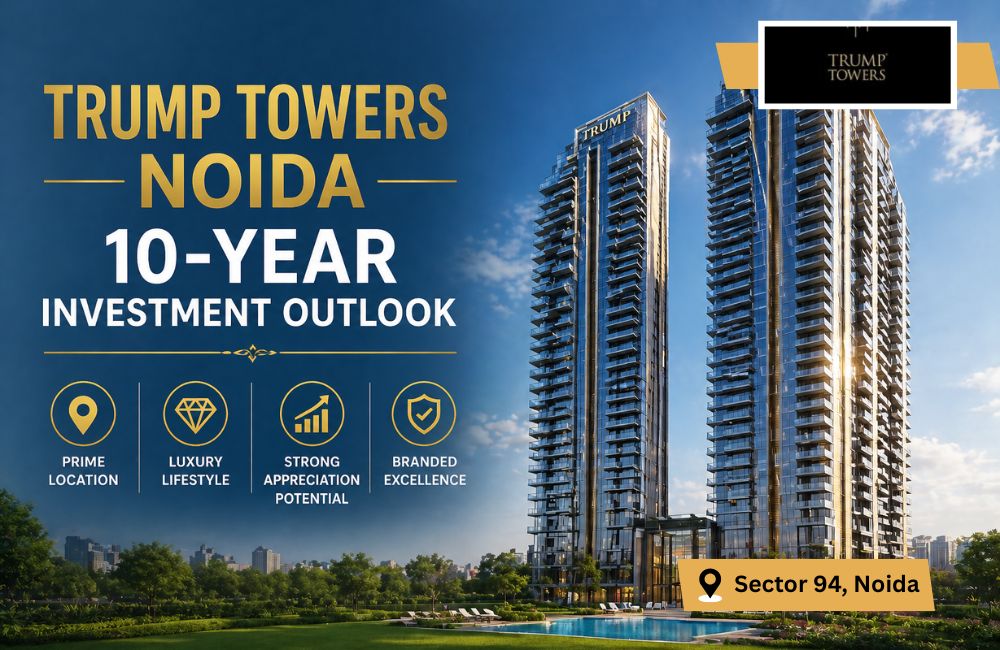
The question of whether Trump Towers Noida will hold its value over the next decade is not just about one luxury project—it reflects the broader dynamics of India’s evolving real estate market, the psychology of wealth, and the long-term sustainability of branded residences. To answer it properly, we need to go beyond simple price speculation and examine multiple layers: location fundamentals, brand power, demand patterns, economic shifts, and potential risks.
Real estate value, at its core, is driven by location. Sector 94 in Noida, where Trump Towers is planned, sits at a highly strategic junction—close to South Delhi, the DND Flyway, and key business hubs. Over the past decade, Noida has transitioned from a satellite city into a major commercial and residential destination.
Infrastructure developments like expressways, metro connectivity, and proximity to upcoming business districts have strengthened its appeal. If this trajectory continues, properties in prime zones like Sector 94 are likely to benefit from consistent demand. However, location alone doesn’t guarantee appreciation—especially in the ultra-luxury segment, where buyer pools are limited.
Trump Towers Sector 94 operates on a branded residence model, where the value is not just in the physical property but also in the brand association. Globally, branded residences often command a premium of 20–30% compared to non-branded counterparts. The idea is simple: buyers are paying for perceived prestige, quality assurance, and a certain lifestyle image.
But the critical question is whether that premium sustains over time.
In India, brand-conscious buying is rising, especially among high-net-worth individuals (HNIs) and non-resident Indians (NRIs). For them, owning a globally recognized branded home carries social and psychological value. However, unlike cities such as New York or Dubai—where such branding has decades of legacy—the concept is still relatively new in India.
Over a 10-year horizon, the brand premium will likely hold only if:
If multiple competing branded residences emerge, the uniqueness—and therefore the premium—could dilute.
One of the biggest risks to long-term value is supply. The ultra-luxury segment in NCR (Delhi–Noida–Gurgaon) has seen increasing launches over the years. Developers are targeting the same niche audience: ultra-wealthy buyers looking for large, high-end apartments.
However, the demand pool for ₹15–20 crore homes is extremely limited. Unlike mid-income housing, where demand is broad and consistent, luxury housing depends on a small group of buyers whose preferences can shift quickly.
If supply grows faster than demand, prices may stagnate or even correct. On the other hand, if developers maintain scarcity and exclusivity, values can remain stable or appreciate gradually.
Another important angle is how the property performs financially. Ultra-luxury homes in India generally offer low rental yields—often in the range of 2–3% annually. This means buyers are not investing for regular income but for long-term capital appreciation and status.
For Trump Towers Noida to hold its value, capital appreciation must compensate for the relatively weak rental returns. This depends heavily on:
If it becomes just another luxury apartment in a crowded market, appreciation may be modest.
Over a 10-year period, macroeconomic factors play a crucial role. India’s economy is expected to grow, and with it, the number of millionaires and billionaires. This expanding wealthy class could support demand for ultra-luxury housing.
However, economic downturns, policy changes, or global financial instability can disproportionately affect luxury real estate. High-end properties are often the first to see reduced demand during uncertain times because they are discretionary purchases.
If India experiences stable growth and wealth creation, Trump Towers Noida has a better chance of maintaining or increasing its value. But in a volatile economic environment, liquidity in this segment can dry up quickly.
One overlooked factor in luxury real estate is maintenance. A property that looks premium at launch can lose value if it is not maintained to the same standard over time.
For branded residences, expectations are even higher. Buyers expect:
If these standards are upheld, the project can retain its elite status. If not, even a strong brand cannot prevent value erosion.
Noida does not exist in isolation. Gurgaon, in particular, has established itself as a hub for luxury housing, with projects like DLF Camellias setting benchmarks. Many wealthy buyers still prefer Gurgaon due to its corporate ecosystem and established reputation.
For Trump Towers Noida to hold its value, Noida must continue improving its perception as a premium residential destination. If Gurgaon continues to dominate the luxury segment, it could limit appreciation potential in Noida.
A key test of value is resale performance. In many luxury projects, initial launch prices are high due to marketing and branding, but resale prices sometimes fail to keep up.
The real indicator will be:
If liquidity is low and properties take long to sell, it indicates weak demand—even if nominal prices remain high.
Trump Towers Noida is likely to hold its value over the next 10 years—but with important conditions.
It is unlikely to see explosive appreciation like mid-income housing in rapidly developing areas. Instead, it may behave more like a “store of wealth” asset, offering stability rather than high returns.
Trump Towers is less about aggressive investment returns and more about exclusivity, lifestyle, and long-term positioning. It can hold value if the ecosystem around it evolves in the right direction—but it is not a guaranteed high-growth asset.
In simple terms: It’s a status-driven investment with moderate financial upside, not a high-return opportunity.
If you want, I can turn this into a YouTube script with hook + storytelling + retention points, or add data-backed comparisons with Gurgaon and Dubai to make it even stronger.
Your information is safe with us. By submitting, you agree to our privacy policy and terms of use.